



WHY OUR PILLOW IS DESIGNED FOR BETTER SLEEP
There is a tendency to treat the pillow as the least considered object in the bedroom. The mattress receives attention, the duvet is selected with some care, but the pillow is often an afterthought, replaced only when it becomes visibly flat, or when neck issues starts to surface.
This is a significant oversight. Of all the surfaces the body contacts during sleep, the pillow is the one in closest, most continuous relationship with the most neurologically critical part of the body: the head, the brain stem, the cervical spine. Every night as we sleep, the pillow is responsible for maintaining the alignment and support of our head and neck. It is also the surface from which you breathe, centimetres away from your nose and mouth, for every minute of that time.
In Singapore, where professional life demands sustained high performance and the hours available for genuine rest are already limited, treating the pillow as incidental is a cost paid slowly – in morning stiffness, in sleep quality that plateaus, in the quiet accumulation of tension that never quite resolves.
THE PHILOSOPHY OF GERMAN ERGONOMICS
dormiente approaches pillow design through the lens of orthopedic geometry. One built on the conviction that form must follow biological function exactly, without aesthetic compromise or production shortcut. This philosophy, applied to our height adjustable latex pillows, makes our pillows quite different from the incorrectly sized pillows commonly found in department stores.
The question is not “what feels comfortable in the first thirty seconds?” but rather “how can tge pillow maintain cervical alignment across eight hours of positional shift, muscular relaxation, and varied sleeping positions?” These are different questions, and they produce different answers.
The cervical spine has a natural curve, when supported correctly during sleep, allows the surrounding musculature to fully release. When the pillow is too low, the head drops laterally and the neck muscles brace to compensate. When it is too high, the cervical vertebrae are pushed into flexion, compressing one side and stretching the other. Either misalignment, sustained across the night, produces the familiar consequence: waking with a neck that carries the residue of the position it was held in for hours.
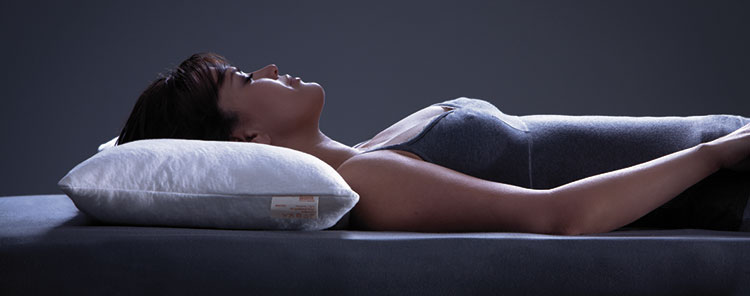
The diagnostic standard dormiente works from is precise: the nose bridge must remain parallel to the mattress surface. This single reference point, maintained throughout the night, ensures the cervical spine holds its natural curve – supported, uncompressed, and free to rest. Achieving it requires a pillow that is calibrated to the specific geometry of the person sleeping on it – their shoulder width, their mattress firmness, their preferred position.
This is not engineering for its own sake. It is the application of human geometry to an object that has, for too long, been treated as a commodity.
STANDARD PILLOW VS. ORGANIC NATURAL LATEX PILLOWS
Understanding why dormiente’s pillows perform differently requires looking honestly at what most pillows are actually made of.
| LOOSE-FILL (FEATHER/ DOWN/ POLYESTER) | Support Consistency Filling migrates away from neck during sleep |
Orthopedic Tailoring None |
Temperature Moderate |
Chemical Safety Often chemically treated; allergen risk |
Structural Longevity Low – compresses and clumps over time |
| SYNTHETIC MEMORY FOAM | Support Consistency Softens unevenly with body heat; sinks |
Orthopedic Tailoring None |
Temperature High — traps body heat at face and neck |
Chemical Safety VOC off-gassing; petroleum-based |
Structural Longevity Moderate – degrades over time |
| DORMIENTE 100% NATURAL ORGANIC LATEX | Support Consistency Resilient, consistent push-back; never shifts |
Orthopedic Tailoring Height adjustable contoured or non-contoured; precision-calibrated |
Temperature Self-ventilating open-cell structure; stays cool |
Chemical Safety 100% certified organic; zero synthetic additives |
Structural Longevity Exceptional – retains form for years |
Loose-filled pillows such as feather pillows, down pillows, polyester fibre pillows tend to thin out, as we shift position through the night, the filling redistributes away from the areas of greatest need, particularly the curve of the neck, leaving the cervical spine without meaningful support precisely when the muscles have relaxed enough to need it most. The pillow that felt adequate at ten o’clock has largely evacuated the neck zone by two in the morning.
Synthetic memory foam pillows present a different problem. It is a petroleum-based material that relies on body heat to activate its contouring response. In Singapore’s ambient warmth, present even in air-conditioned bedrooms, this means the foam can radiate accumulated warmth back toward the head and neck throughout the night. It also off-gasses volatile organic compounds continuously, at low but persistent levels, directly into the breathing zone.
dormiente’s natural latex pillows are certified organic, independently audited, free from synthetic materials or petrochemical processing agents. No chemical flame retardants. No antimicrobial coatings achieved through chemistry. No adhesives, synthetic dyes, or treatments of any kind applied to the cover fabric.
It is a categorically different material, and it behaves accordingly: resilient without being rigid, responsive without sinking, cool without requiring the room to do all the work.
Organic natural latex is an open-cell material. Air moves continuously through its internal structure, carrying moisture away from the surface and preventing heat accumulation. The head remains cool not because the room is cold, but because the pillow is actively ventilating. In a tropical climate where this dynamic is tested nightly, the difference between a self-ventilating pillow and a heat-retaining one is not subtle, it is the difference between a night of genuine rest and one spent in the shallows.
PURE CRAFTSMANSHIP, ZERO TOXINS
The dormiente pillow range in Singapore comprises five models, each expressing a distinct orthopedic intent. The contoured pillows offer differentiated support zones that cradle the head in the central recess while the lateral elevation supports the neck, ideal for side and back sleepers who carry consistent tension in the cervical region.
The non-contoured pillows deliver the same certified organic latex resilience in a familiar shape, suited to those who shift positions frequently or prefer a less prescribed silhouette. Both types of pillows are available as a physiotherapy recommended 40cm x 80cm size for better fit, and height-adjustable to the individual to determine the correct cervical alignment: shoulder width, mattress firmness, sleeping position.
To find the correct pillow best suited to your profile, book a private consultation now