







WAKE UP WITHOUT NECK PAIN. IT STARTS WITH THE RIGHT PILLOW.
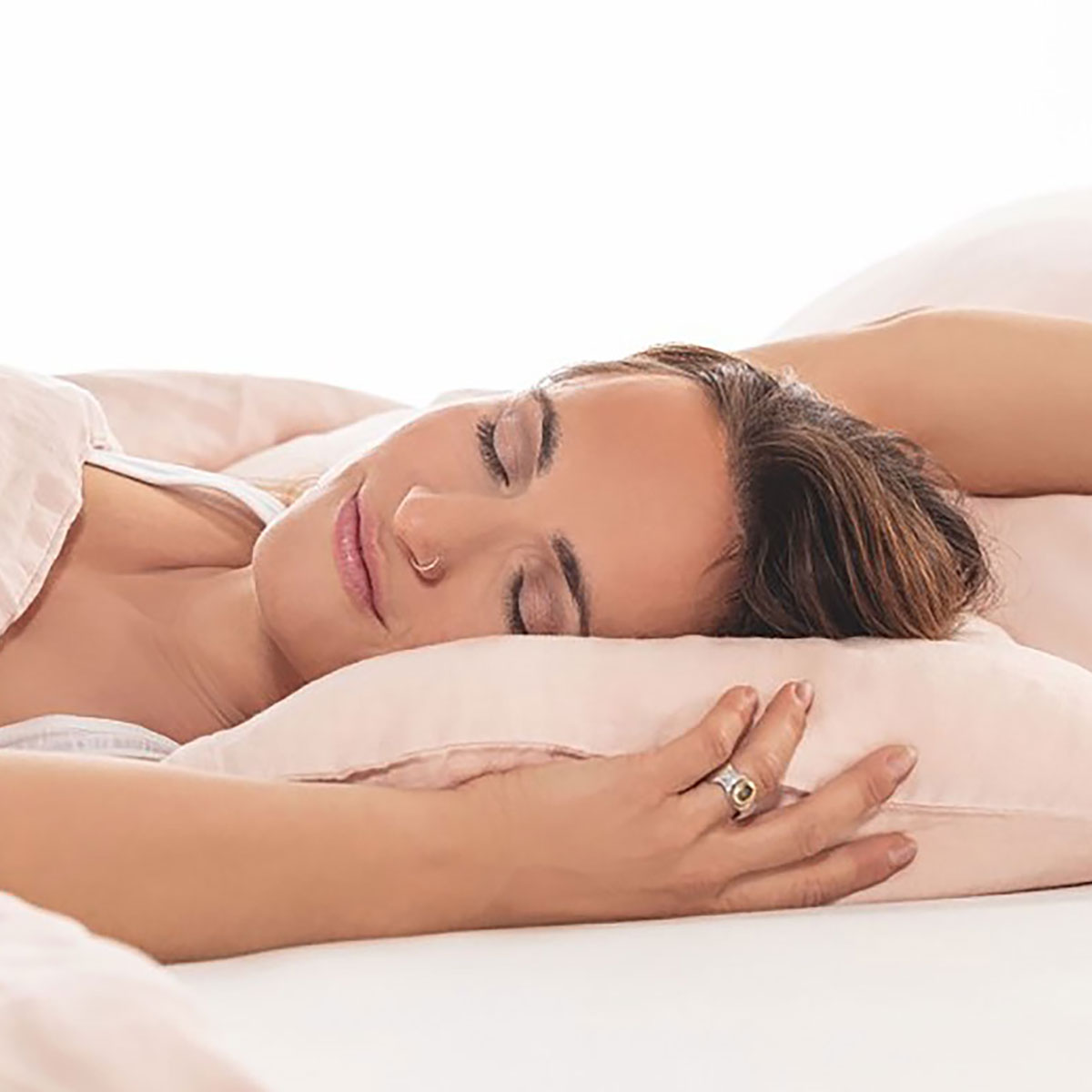
There is a particular kind of morning that many Singaporeans know well. The light filtering through the blinds is already bright, and before you have even reached for your phone, you feel it – a dull, insistent pull along one side of your neck, a stiffness at the base of the skull and discomfort, that is mild but unmistakable.
It feels like a small thing. By mid-morning, with enough coffee and movement, it loosens. But it returns the next day, and the day after that, and after a while it begins to feel like simply the way things are, an unavoidable aspect of adult life in a city that demands so much.
It is not. It is, in most cases, a geometry problem. And it begins with your pillow.
THE NECK AS BRIDGE
The cervical spine performs one of the most thankless tasks in the body. It carries the weight of the skull, roughly five to six kilograms, through every hour of waking life, rotating, extending, flexing, absorbing the cumulative load of hours, bent over a laptop at work or angled down toward a screen on the MRT. By the time evening arrives, the musculature surrounding the cervical vertebrae is already carrying a quiet residue of tension.
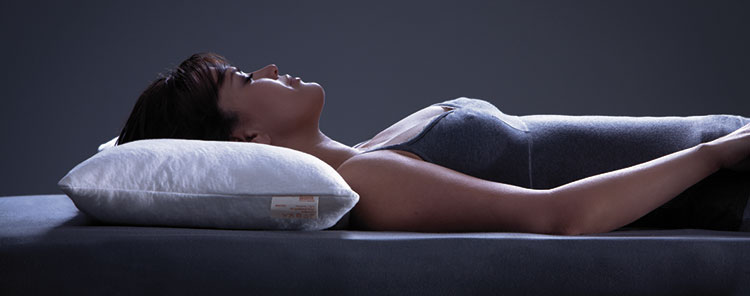
Sleep is when that tension is meant to resolve. The muscles release, the fascia softens, and the spine, freed from the vertical demands of gravity, can decompress and recover. If the pillow beneath your head is not holding the cervical spine in correct alignment – nose bridge parallel to the mattress, the lateral curve of the neck gently supported, those muscles will stiffen in whatever position they are left to hold. By morning, that stiffness is not imagined. It is structural.
THE MATERIAL: WHAT YOUR PILLOW IS ACTUALLY MADE OF
There are ample pillow options. Most of them, examined closely, are not designed around cervical anatomy at all, but attracts with price points and the feel of the showroom.
| PILLOW TYPE: FEATHER/ DOWN/ POLYESTER FILL | Support Structure Fills shift away from neck during sleep |
Heat Retention Moderate |
Chemical Safety Often treated with chemicals |
Durability Low – compresses over time |
| PILLOW TYPE: SYNTHETIC/ MEMORY FOAM | Support Structure Softens unevenly with body heat; sinks |
Heat Retention Very high – traps tropical heat |
Chemical Safety VOC off-gassing; petrochemical base |
Durability Moderate – degrades over time |
| PILLOW TYPE: ORGANIC NATURAL LATEX | Support Structure Instant, resilient push-back; never shifts |
Heat Retention Naturally self-ventilating; stays cool |
Chemical Safety 100% toxic-free; no synthetic additives |
Durability Exceptional — retains form for years |
Loose-fill pillows – whether feather pillow, down pillows, or polyester fibre pillows have a fundamental mechanical flaw: their contents migrate. During the night, as you shift position, the filling moves away from the areas that most need support, particularly the curve of the neck. By three in the morning, the pillow that began with adequate loft has redistributed itself around your head, leaving the cervical spine essentially unsupported against the mattress.
Synthetic memory foam pillows present a different problem, one particularly relevant in Singapore’s climate. Memory foam relies on body heat to activate its softening and contouring response. In a tropical environment, even with air-conditioning, this means the foam retains and radiates heat back toward the face and neck throughout the night. For many sleepers here, memory foam pillows become noticeably warm within an hour of use, an uncomfortable irony in a city that sleeps with the air-con running precisely to stay cool.
There is also the question of what memory foam is made of. Polyurethane foam is a petrochemical product. It off-gasses volatile organic compounds (VOCs) continuously, at low levels, for months or years after manufacture. These are the same compounds that give new furniture and packaging that distinctive chemical smell. The difference, with a pillow, is that your face rests within centimetres of the surface for eight hours a night.
Organic natural latex pillows behave differently in every relevant dimension. Derived from the Hevea brasiliensis rubber tree and processed without synthetic additives, it offers immediate, resilient support, pushing back against the weight of the head with consistent, even resistance that does not shift, compress, or sag over time. Its open-cell structure allows air to circulate freely through the material, making it naturally temperature-neutral: cool when the room is cool, without the trapped-heat problem that plagues synthetic foams. And it contains nothing that does not belong in a breathing zone.
FINDING YOUR SILHOUETTE: CONTOURED OR NON-CONTOURED
dormiente offers four natural latex pillow models in Singapore, each one expressing a distinct ergonomic philosophy. Understanding the difference between them is less about preference and more about listening carefully to what your body actually needs.
The Contoured Natural Pillows are engineered with a wave-like profile: a lower central zone that cradles the head and elevated lateral edges that support the neck as it bridges the gap between head and shoulder. This architecture is designed with purpose. For side sleepers and back sleepers who carry chronic tension in the upper back and neck, those whose mornings most reliably begin with that familiar stiffness – the contoured form provides the kind of strict, consistent orthopedic alignment that a flat surface simply cannot replicate. The curve is not decorative. It is the solution to a geometric problem.
The Non-Contoured Natural Pillows take a more conventional approach. The shape is familiar: a traditional rectangular profile that most sleepers have grown up with. What changes is everything beneath the surface. The same 100% organic natural latex fill offers the identical resilient, temperature-neutral, chemically pure support — simply delivered in a form that feels intuitive from the first night. For those who find the contoured profile too structured, or who shift frequently between positions during sleep, the non-contoured models offer the full benefit of natural latex without any ergonomic prescription.
Both types are height-adjustable, allowing you to fine-tune the loft to match your shoulder width, your mattress firmness, and your preferred sleeping position, because the correct pillow height is not a universal number. It is the height at which your nose bridge remains parallel to the mattress surface, your cervical spine holds its natural curve, and your neck muscles are finally free to rest.
THE BREATHING ZONE
There is one dimension of pillow choice that rarely appears in product descriptions but deserves to be considered with some seriousness: you breathe through your pillow.
Not literally, but the air that reaches your face, your nose, your mouth throughout the night passes directly over and through whatever material your pillow is made of. For eight hours, while your nervous system quiets and your immune system works and your body undertakes the careful biochemical work of restoration, the air in your immediate breathing zone is shaped by your pillow’s composition.
A pillow made from synthetic petrochemicals, treated with flame retardants or antimicrobial coatings, is not a neutral presence in that zone. It is an ongoing, low-level chemical exposure during the hours when your body is most receptive and least defended.
dormiente pillows introduce nothing into that zone except the inert, naturally breathable structure of organic latex and untreated natural plant fibre covers – materials that have nothing to release, nothing to off-gas, and nothing to justify concern. It is a simple standard, but in the context of where the pillow rests in your life, it is not a small one.
A NEW MORNING RITUAL
Sleep is not a passive activity. It is the period during which the body does its most essential maintenance — and the quality of that maintenance depends, more than most of us appreciate, on the physical conditions we create for it.
In Singapore, where the pace of professional life is relentless and recovery time is often compressed, the hours of sleep you do have are worth protecting with some care. The right pillow does not merely prevent neck pain. It removes the single most common physical impediment to genuine, restorative sleep – the low-grade muscular bracing of a cervical spine that was never given the support to let go.
Waking up without neck pain over time, and you begin to forget it was ever there. That forgetting is not trivial. It is what good sleep, are supposed to feel like.